Which Of The Following Is Not An Example Of Scaffolding . Vygotsky believed that scaffolding limited communication between the teacher and the learner. In the scaffolding model, a teacher. DIFFERENCE BETWEEN SCAFFOLDING, SHORING & UNDERPINNING from civilblog.org Which of the following is not an osha standard for using boatswain's chairs? In step 5 open again command prompt and type the following. Scaffolding is a temporary structure, made up of wooden planks and metal poles, to support the workmen in constructing, maintaining, and repairing a building.
Power Of A Quotient Examples. Dividend ÷ divisor = quotient (if the remainder is zero) the general formula for any division problem is given by: It states that the quotient of any two same exponents with different bases is equal to the exponent with quotient of their bases.
Quotient of powers property from www.slideshare.net
This is the currently selected item. There is a property for dividing the same indices with different bases and it is called power of a quotient rule. Since, x0 = 1, then f ’ ( x) = (1) ( x0 )= 1.
They Form Two Exponential Terms B M And C M.
What is the power of a quotient rule? Rewrite the original problem differently and look at. Working with fractions can be intimidating, but if you arm yourself with the right tools, you'll find that working with fractions is no harder than working with basic numbers.
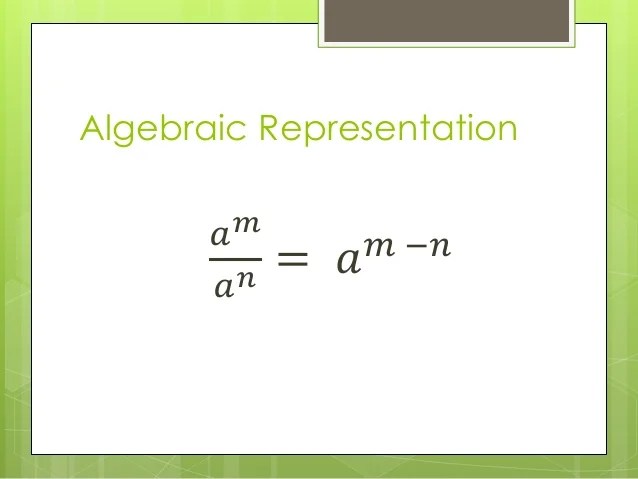
In This Process, We Subtract The Values Of The Exponents, Keep The Original Base, And Eliminate The Fraction Line.
It states that the quotient of any two same exponents with different bases is equal to the exponent with quotient of their bases. Check out this tutorial to learn about these two. The quotient rule follows the definition of the limit of the derivative.
In Other Words, For All Real Numbers A , B And C , Where A ≠ 0 , A B A C = A B − C.
Example #1 (no variables) example #2 (with variables) practice. Learn how this rule works along with examples in simple and complex division problems. How do you multiply fractions?
In The Second Instance, In Order To Carry Out The Division, A Single Fraction Must Be Assumed As Power, And The Values Of The Natural Numbers That Exercise As Quotient Must Be Subtracted.
It is a formal rule used in the differentiation problems in which one function is divided by the other function. Dividend ÷ divisor = quotient + remainder. Quotient of powers is a formula that lets us simplify terms with exponents that need to be divided.
It Is A Rule That States That The Derivative Of A Quotient Of Two Functions Is Equal To The Function In The Denominator G(X) Multiplied By The Derivative Of The Numerator F(X) Subtracted To The Numerator F(X) Multiplied By The Derivative Of The Denominator G(X), All Divided By The Square.
There is a property for dividing the same indices with different bases and it is called power of a quotient rule. B, c and m are literals and they are constants. The quotient of powers rule states that when dividing two powers with the same base, just subtract the exponents.


Comments
Post a Comment